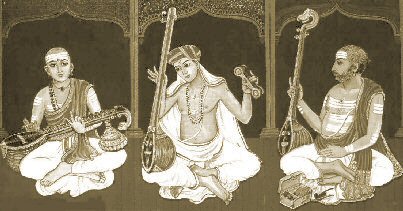
Carnatic Music also known as Karṇaṭaka Sangītam in India, is the classical
music tradition from the southern part of the Indian subcontinent. Like all art
forms in Indian culture, Carnatic Music is believed to have divine
origins-- it is believed to have originated from the Gods. The Gods themselves
are regarded as the very personification of Music or Nādasvaroopa. As
a result many of the Hindu Gods are portrayed as being closely associated with
music. The commonest examples are Goddess Sarasvati with the Vīṇa or Lute & Lord Krishna
with the Flute. Music with its sacred associations is regarded as a spiritual
discipline, that leads the individual to the path of salvation.
The origins of Classical
Indian music can be traced back to nearly 2000 years to the source of its
origin - the Vedas which are the ancient sacred texts of the Hindus. The Sāma
Veda is said to have laid the foundation for Indian music, and consists
mainly of Rgvedic hymns set to melody which would be sung using 3
to 7 musical notes during Vedic sacrifices. The Yajur Veda, which
mainly consists of sacrificial formulae, mentions the Vīṇa as an accompaniment to
vocal recitations during the sacrifices. For several centuries Carnatic
Music has maintained a strong association with temples & spiritualism
and hence this spiritual quality finds a place in most musical performances.
Carnatic Music rests on two main elements:
rāga, the modal system, and tāla, the metrical system.
The rāga system is based on the scheme of the 72 Melakarta-s.
There are an infinite number of rāga-s and each having its own
identity. Each rāga is invested with its individuality by
means of factors such as ornaments or gamakā-s, characteristic phrases
etc. The exoticism that underlies a rāga improvisation is
in understanding its spiritual essence & subtleties. The tāla system
is rhythmic, varied & complex. The tāla-s are rhythmic cycles
executed with a specific number of beats. The basis of the tāla system
is the Sapta tāla-s or the Seven tāla-s.
As a Music system, Carnatic
Music lays equal emphasis on improvisatory music as well as pre-composed
music. There are different forms of improvisatory Music such as Rāga ālāpana,
Tanam, Niraval, Kalpana Svara. The pre-composed music consists of
different musical forms such as Gitam, Jatisvaram, Svarajati, Varnam,
Kriti, Tillāna, Rāgamālika etc.
Some of greatest composers
of Carnatic Music , whose compositions are rendered even today include
Saint Purandaradasa, the Trinity - Saint Tyagaraja, Muthuswami Dikshitar &
Syama Sastri, Svati Tirunal, Saint Annamacharya, Saint Arunagirinathar,
Narayana Teertha, Sadasiva Brahmendrar, Oothukadu Venkatasubbiyer,
Arunachalakavirayar, Marimutta Pillai, Patnam Subramanya Iyer, Mysore
Vasudevachar, Ramanathapuram Srinivasa Iyengar, Muthaiah Bhagavathar,
Gopalakrishna Bharathi, Kotisvara Iyer, Neelakanta Sivan, Papanasam Sivan etc.
Traditionally, Carnatic
Music is taught in the Guru-Sishya tradition, where knowledge
is imparted by the Guru or Master to the Sishya or
disciple. The Guru is venerated and it is important to secure his
grace and blessings in order to gain mastery over the discipline.
The contemporary Carnatic
concert can be either Vocal or instrumental. Vocal concerts are accompanied by
melodic & percussion instruments while instrumental concerts are
accompanied by percussion instruments. The drone is provided in the concerts by
the Tambura/Sruti box.
The Carnatic concert format
or the Katcheri Padhati consists of varied musical forms featured
in a concert lasting for a duration of about 3 hours. Different forms of
melodic/rhythmic improvisations such as the Rāga ālāpana, Niraval,
Kalpana Svaram etc. are performed. Lighter pieces known as Tukkadā-s
are performed towards the end of the concert.
Carnatic Music is a musical genre that is
artistic yet scientific. Its spirituality & devotional content has made it
a musical system that is not merely entertaining but one which enriches the
soul.
